

The Fake Settlement Check That's Still Draining Law Firm Trust Accounts in 2026
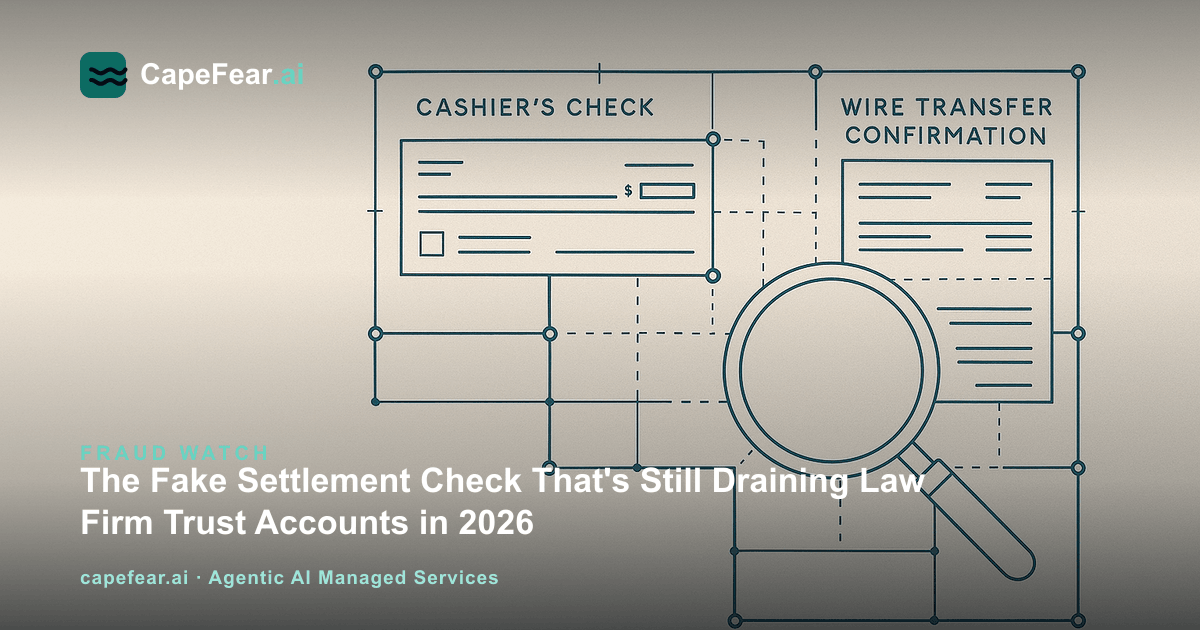
In April 2026, the State Bar of Texas flagged a scam that was already moving through plaintiff firms in Texas, New York, Washington D.C., and Florida. A new "client" calling himself Mr. Lopez signs up online, claiming a workplace injury with dozens of facial stitches and an employer who supposedly owes him a $250,000 settlement. Letters from a fake HR contact back up the story. Then a cashier's check for the full amount arrives at the firm, right on schedule. The firm deposits it, tells the client, and he immediately asks for his share. By the time the check bounces, days later, the firm has already wired out money that was never real.
It is not a new idea. Bar associations have been warning about versions of this for over a decade. What is new is how current it still is, and how little the pattern has had to change to keep working.
The same handful of moves, over and over
The California State Bar's fraud alert groups most of these scams into four repeating types: criminals impersonating a real attorney using a stolen name and bar number, fake clients who fund a trust account with a bad check, wire instructions quietly swapped after someone's email gets compromised, and phishing messages built around urgency. The Texas Bar's own case log from the past year adds detail to the same categories: a wire-redirect attempt on an eight-figure settlement using an email address one character off from opposing counsel's real one, and a separate case where a counterfeit check against a nonexistent account cost one attorney roughly $80,000 once the bank clawed the funds back.
The mechanism behind the email-based version has a name, business email compromise, and the FBI has been tracking it since 2013. The Florida Bar's own warning to its members cites more than 7,000 reported victims and $740 million in losses from the scheme, with a 270% jump in reported cases once attorneys and real estate closings became a preferred target. The number one piece of advice from every bar association that has written about this: verbally confirm any change to wiring instructions using a phone number you already had on file, never one from the email that just asked you to change something.
Why trust accounts are the target, not a side effect
Trust accounts make an appealing target for a simple reason: the rules that protect clients also create pressure to move fast. Attorneys are required to disburse client funds promptly once they clear, and "promptly" is exactly the window a scammer is counting on. A bad check can look cleared for days before a bank reverses it, and by then the firm has already sent money that was never actually there. The fix bar associations keep repeating is not a new rule, it's slowing down the one moment that matters: before anything leaves the trust account, someone confirms the inbound funds actually settled, and confirms any wiring instructions through a channel the scammer never touched.
What actually catches this before it costs you
None of these scams rely on sophisticated hacking. They rely on a firm's own process being fast and trusting under pressure. A few habits catch most of it:
- Treat a late check-the-day-settlement and a fast request to disburse right after as a combination worth a second look, not a convenience.
- Confirm any changed wire instructions by calling a number from your own file, never the number in the email that asked for the change.
- Verify a check has actually cleared and settled with the bank directly before disbursing, not just that it stopped showing as pending.
- Flag new clients whose only urgency is speed of payment and who avoid an in-person or video meeting.
The hard part is not knowing the rule. It's remembering to apply it the same way every time, on every new matter, when the inbox is full and the request looks routine. That is the kind of repetitive checking an AI agent handles well: it can read incoming client intake, flag a settlement check that doesn't match the pattern of the matter, or hold a disbursement request until the funds are confirmed cleared, and put that flag in front of a person before anything moves. The agent reads and proposes. Someone on your team still approves anything that actually sends money.
More on how that division of labor works on the how it works page, and what we do and don't automate for law firms on the legal page.
Sources: State Bar of Texas, scams continuing to target Texas attorneys (April 2026), California State Bar fraud alert on scams impacting attorneys, and The Florida Bar News on the wire transfer scam targeting lawyers.